 |
 |

|
|

|
|
||||
|
|
|||||
| HEALTH
EQUATIONS AND STANDARD PROCESS:
A Case for Urgent Intervention |
|||||
|
The Essential Videos and Health Professionals' Notebook The Health Equations Blood Test Evaluation Individual Food Plans |
|||||
|
|
|||||
|
|
|||||
|
Intake Form, Health Survey |
|||||
|
|
|||||
 |
The Health Equations Blood Test Evaluation |
The Health
Equations Blood Test Evaluation identifies, quantifies, and monitors pathogenic
lipids in body tissues. For
almost every symptom and disease there are pathogenic lipids in the corresponding
tissue. Pathogenic lipids interfere with normal cellular and tissular
functions.
| PATHOGENIC
LIPIDS
. . . cause electrolyte imbalances . . . decrease mineral function . . . disrupt membrane permeability . . . promote free radical formation . . . increase anaerobic metabolism . . . increase calcium loss and deposition |
The term pathogenic lipid was coined by Emanuel Revici MD (1897-1998), who for nearly 75 years documented the causative role of these lipids in cellular and tissular physiopathology. According to Revici, these pathogenic lipids must be eliminated to effectively treat a wide range of pathologies, from arthritis and cardiovascular disease to cancer.
Pathogenic lipids can
be eliminated through dietary and lifestyle modifications and through ingested
"therapeutic" lipids. Cellular and tissular physiology can then be corrected
with electrolytes and minerals.
The Health Equations Blood Test Evaluation also identifies, quantifies, and monitors:
| electrolyte
deficiencies and imbalances;
dietary adequacy and excess; mineral function; cell function; immune status and activity; and glandular, organ, and system functions. |
"The Health Equations approach provides a nutritional foundation that makes conditions like backache, fibromyalgia, and chronic fatigue simpler and sometimes even unnecessary to treat"
The Score PlotThe result of each component of the Chem 26 Profile and CBC is "scored" in comparison to an optimum value.
The Score Plot is a graphical representation of the scores of select components and Indices.
Relationships and patterns among test components are reported as "Indices."
The InterpretationsA brief paragraph explains the significance of each score on the Score Plot that is above or below the "functional range."
The RecommendationsSpecific to each patient's Blood Test Evaluation, the recommendations include:The expertise of the clinician allows modification of the Recommendations based on the clinical situation and the employed therapeutic modalities.dietary modifications;
lifestyle changes;
indications for specific Health Equations Formulas.
Most blood test evaluation systems are correlation databases. They correlate blood test results with possible deficiencies and diagnoses and recommend multiple nutritional supplements. Furnishing the body with diagnoses and supplements without eliminating the pathogenic lipids and correcting cell and tissue physiopathology is inefficient and expensive.
The Health Equations Blood Test Evaluation is the only evaluation that quantifies pathogenic lipids and their correction. It is the only evaluation that specifically addresses the physiology and physiopathology of cells and tissues.
 |
Health
Equations and Standard Process:
A Case for Urgent Intervention |
Iris is a 58 y/o professional female presenting with pounding in the head and chest, symptoms of early neuropathy in her lower extremities, intermittent numbness in her arms and hands (especially the left), "spikes" in her blood pressure and exhaustion. She is following a Zone-type diet, walking, drinking water, using salt-to-taste, getting regular massage and pursuing her spiritual practice. She is 25 pounds overweight. Her mother is aging gracefully at 83, her father died in his early fifties of heart disease. Iris' only medical history is a fibroidectomy. She does not take hormones, has had an uneventful menopause, and reportedly has "good" bone density.
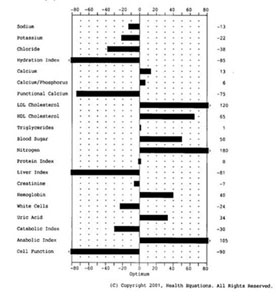
INTERPRETATION, RECOMMENDATIONS and OUTCOME
Interpretation
Iris's chloride is
low because her Anabolic Index is high. The Anabolic Index is high because
the LDL Cholesterol and the Blood Sugar are high (5 hrs pp). Her
BUN is high because she is dehydrated (hydration Index minus 85).
She is dehydrated because her electrolytes are out of balance, caused by
the high cholesterol.
Her cholesterol is high because her Liver Index, i.e., liver function, is minus 81! The dehydration is the most significant insult to her liver function. Further, a high (or low) Blood Sugar points to compromised adrenal function.
Although Iris' Calcium Score is close to zero, her Functional Calcium - the ionized or active calcium - is minus 75. The ionized calcium regulates everything from the heart, nerves and muscles to hormone function and cell membrane permeability/charge. Thus the low Functional Calcium is implicated as a factor in each of her symptoms.
The Uric Acid score of 34 raises suspicion of a fungal overgrowth, especially in light of the high Blood Sugar.
Here is the vicious cycle...the electrolyte imbalance causes the dehydration which compromises liver and adrenal function. Compromised liver and adrenal function results in impaired cholesterol metabolism/utilization and poor blood sugar control. Moreover, the high cholesterol and the compromised adrenal function further disrupt the electrolyte balance.
In summary, the cell
and tissue physiopathology result in, and are a result of, the organ and
glandular dysfunction. Together they are responsible for the threatening
cardiovascular symptomatology. If there were not threatening symptomatology
there would be the luxury of time. Time would allow correction of
the cell and tissue physiopathology, often sufficient to restore organ
and glandular function. Such was the outcome for "Mary," see Example
Blood Test Evaluation. However, given the urgency of Iris' symptomatology,
BOTH cell and tissue physiology AND organ and glandular functions must
be addressed simultaneously and immediately.
Recommendations
1) Iris is referred to her Internist for a cardiac evaluation, glycosylated hemoglobin and fasting serum insulin.
2) Reconstituted Health Equations Lyte CL Solution, minimum three 8oz glasses per day, one with each meal. Iris is encouraged to drink more Lyte CL Solution according to taste. Her total glasses of reconstituted Lyte CL plus water per day must be at least eight glasses. See Health Equations Formulas.
3) Continue "salt-to-taste," using an unprocessed salt. See Water and Salt, salt references in Another View , and the Literature Bite Questioning the Evils of Salt.
4) One Health Equations Calcium and one Health Equations Mineral after each meal. See Health Equations Calcium and Minerals.
5) Phase 1 (detox) Individual Food Plan. See Individual Food Plan.
6) The following Standard Process Whole Food Supplements are selected for glandular and organ nutritional support according to Iris's Health Equations Intake Form, her Health Equations Blood Test Evaluation, and her Standard Process Symptom Survey Form (from the Standard Process Clinical Reference Guide, www.standardprocess.com):
Diaplex, Drenamin, Cardio-Plus, Cataplex E2, A-F Betafood, Multizyme and Thytrophin PMG.
7) Continue walking
and massage. Consider acupuncture.
Outcome
Within a few weeks all of the symptoms Iris initially presented with, as described above, resolved completely. Her blood pressure registered 130/60.
A repeat Blood Test Evaluation two months later shows a slight decrease in the LDL cholesterol and the same HDL cholesterol. There are marked decreases in the BUN score from 180 to 0 and in the Blood Sugar score from 50 to minus 8. The Hydration Index increased from minus 85 to minus 45. Her Liver Index did not improve, hence the remaining high LDL cholesterol. And her Functional Calcium score did not improve, again due to the high LDL due to the low Liver Index.
Iris continues on the same Health Equations Formulas. She continues to "crave" the reconstituted Lyte CL Solution.
Iris' Symptom Survey Form shows dramatic improvement in liver function and the sympathetic and parasympathetic nervous system function. There are improvements, with remaining stressors, in the cardiovascular system and thyroid and adrenal function. The following adjustments are in effect in her Standard Process supplementation: Zypan replaces Multizyme, Simplex F replaces Thytrophin PMG and Cholaplex and Livaplex are added. Choline, Garlic and Phytolin are other considerations.
NOTE: There will be a new case presented monthly for clinicians using the above format. There is also another general public discussion available - - Go to THE BLOOD TEST EVALUATION.
 |
Goods and Services |
The
Health Equations Essential Videos
For the first time,
you will be able to attend Health Equations seminars without leaving home!
VIDEO #1*Introduces the work of Lynne August's mentor, Emanuel Revici, MD.SUBSEQUENT VIDEOS will:*Explains the Health Equations Blood Test Evaluation (BTE), showing how Revici's original research on dualism and the lipid defense are incorporated.
*Demonstrates how the Score Plot is generated and used in clinical application.
*Includes many case examples.
*Describes the physiologic functions of the Health Equations formulas.
*Describe the Health Equations Blood Test Evaluation Analysis from which the Score Plot is derived.*Explain the Comparison. The Comparison is included in the Blood Test Evaluation whenever there are two or more analyses on the same patient.
*Discuss the the use of Standard Process Whole Food Supplements in conjunction with the Health Equations Blood Test Evaluation.
HEALTH
EQUATIONS ESSENTIAL VIDEOS #1 is now available
with an accompanying Health Professional
Notebook
and can be ordered by calling
the Health Equations office:
1-800-328-2818
Score Plot, lnterpretations, Recommendations from Chem 26 Profile and CBC
* via the Internet using your own lab-- online access to Health Equations' Software* at Health Equations, using your lab report
* at Health Equations, using Health Equations Lab Kit(s)
To get started, call: 1-800-328-2818 or e-mail: [email protected]
Via the Internet: enter patient data from Health Equations Intake Form and Blood Test Evaluation Score PlotThe Individual Food Plan calculates the functional protein/CHO/fat ratios for each individual.
The Individual Food Plan includes Meal Menus, Snack Suggestions, Food Lists, Basic Guidelines, and more.
To set up an on-line account
for Blood Test Evaluations or Individual Food Plans
call: 1-800-328-2818 or e-mail:
[email protected]
|
|
| Lyte Solution Concentrate - 16 oz. bottle |
| Lyte Cl Solution Concentrate - 16 oz. bottle |
| Lyte K Solution Concentrate - 16 oz. bottle |
| Health Equations Calcium - 90 capsules/bottle |
| Health Equations Minerals - 90 capsules/bottle |
| Malic Acid - 180 capsules/bottle |
| Ammonium Chloride - 120 capsules/bottle |
| EPA 300 - 90 capsules/bottle |
| GLA 10 - 90 capsules/bottle |
DESCRIPTION OF FORMULAS
Lyte Solution Concentrate - 16 oz. bottleHEALTH EQUATIONS CALCIUM AND MINERALS: The Health Equations mineral products are a proven effective way to deliver minerals to the site of mineral absorption, the small intestine. It is important to realize that mineral supplementation alone is not sufficient to ensure mineral function. The necessary amounts and activities of the electrolytes and organic elements are critical for calcium and mineral activity.One 8 oz. serving of reconstituted Lyte Solution contains: 180 mg Sodium, 260 mg Chloride, 40 mg Potassium, 70 mg Phosphate, 20 mg Magnesium,122 mg Sulfate. In addition to these major electrolytes the solution contains less than 1 mg each of 65 trace elements.Lyte Cl Solution Concentrate - 16 oz. bottleOne 8 oz. serving of reconstituted Lyte Cl Solution contains: 135 mg Sodium, 333 mg Chloride, Potassium, 70 mg Phosphate, 20 mg Magnesium, 122 mg Sulfate. In addition to these major electrolytes the solution contains less than 1 mg each of 65 trace elements.Lyte K Solution Concentrate - 16 oz. bottleOne 8 oz. serving of reconstituted Lyte K Solution contains: 120 mg Sodium,163 mg Chloride, 98 mg Potassium, 170 mg Phosphate, 20 mg Magnesium, 166 mg Sulfate. In addition to these major electrolytes the solution contains less than 1 mg each of 65 trace elements.
Health Equations Calcium - 90 capsules/bottleMALIC ACID: Malic Acid provides both malate, a form of carbon which increases the energy production of the cell, and hydrogen.Each 500mg capsule contains 100mg calcium in a base of colloidal clay.Health Equations Minerals - 90 capsules/bottleEach 500 mg capsule contains 50 mg Magnesium, 25 mg Calcium,For more information, go to: Health Equations Calcium and Minerals.
1.5mg Zinc, 0.35 mg Copper, 0.1 mg Manganese, 0.03 mg Chromium, and
0.012mg Molybdenum in a base of colloidal clay.
Malic Acid - 180 capsules/bottleEach capsule contains 300mg Malic Acid.
AMMONIUM
CHLORIDE: Ammonium
Chloride provides a biologically active form of nitrogen for those individuals
whose Health Equations Blood Test Evaluation shows low available nitrogen.
Taking Ammonium Chloride can increase the "currency" or "circuitry" in
the body's electrical system. It is not recommended to take Ammonium
Chloride unless there is blood test monitoring.
Ammonium Chloride - 120 capsules/bottleEPA & GLA: EPA and GLA are both fatty acids. EPA is found in fish oils and GLA is the active form of linoleic acid. Linoleic acid is the one essential fatty acid for humans. It cannot be made in the body and must be ingested. Although linoleic acid is found in most foods, both high carbohydrate diets and stress inhibit its conversion to GLA.Each capsule contains Ammonium Chloride (7.5 grains) 490 mg buffered with <10 mg of magnesium and <10 mg of calcium.
EPA 300 - 90 capsules/bottle
Each capsule contains 300mg EPA (eicosapentaenoic acid), 200 mg DHA (docosahexaenoic acid), 1 l I.U.Vitamin E.GLA 10 - 90 capsules/bottle
Each capsule contains 10 mg Gamma Linolenic Acid from borage oil.
NOTE: The cost of EPA 300 is greater than that of most EPA supplements because great care is taken to provide the highest quality fish oil available.
The Health Equations EPA 300 . . .*comes from salmon, mackerel or tuna, not cod liver oil,
*is processed thorough molecular distillation to remove PCBs and cholesterol
*is produced in very small batches to guarantee minimum shelf time and a very fresh product for the end user.All omega 3 and omega 6 oils are highly subject to oxidation and rancidity. An independent assay comparing EPA 300 to another EPA supplement, produced by a well known quality supplement producer, showed that the EPA 300 had a rancidity level one fourth that of the other EPA. To reduce lipid peroxidation in tissues we feel EPA supplementation should be with only the highest quality product available.
 |
Another View |
SALT
Salt Deficiency
The Health Equations
Blood Test Evaluation reveals the link of salt deficiency with hypotension
and hypertension; increased susceptibility to colds, flus and infections;
fatigue; inflammation; hypoglycemia; eczema; dehydration; and elevations
in LDL cholesterol.
Cravings
for Salt and Aversions to Salt
Nervous exhaustion
is an increasingly prevalent consequence of stress. The hallmark
of nervous exhaustion is the inability to relax in spite of chronic fatigue.
An unstable blood sugar, hormonal and sleep disturbances, decreased ability
to handle stress, and decreased ability to experience pleasure all are
common. Nervous exhaustion occurs when the adrenal medulla is hyperactive
and the adrenal cortex is hypoactive. The hyperactivity of the medulla
means increases in adrenaline and sympathetic autonomic activity.
The hypoactive cortex means decreases in corticosteroids, including
mineralocorticoids. The first, easiest, least expensive and most
frequently overlooked remedy for nervous exhaustion is salt. Nervous
exhaustion is both caused by, and causes, a salt deficiency.
Nervous
Exhaustion and Salt Deficiency
Nervous exhaustion
is an increasingly prevalent consequence of stress. The hallmark
of nervous exhaustion is the inability to relax in spite of chronic fatigue.
An unstable blood sugar, hormonal and sleep disturbances, decreased ability
to handle stress, and decreased ability to experience pleasure all are
common. Nervous exhaustion occurs when the adrenal medulla is hyperactive
and the adrenal cortex is hypoactive. The hyperactivity of the medulla
means increases in adrenaline and sympathetic autonomic activity.
The hypoactive cortex means decreases in corticosteroids, including mineralocorticoids.
The first, easiest, least expensive and most frequently overlooked remedy
for nervous exhaustion is salt. Nervous exhaustion is both caused
by, and causes, a salt deficiency.
Comment: HRT will increase cardiovascular disease (CVD) in any woman who has an elevated Anabolic Index. An Anabolic Index is calculated from the results of a Chem 26 Screen and CBC. The Anabolic index quantifies anabolic lipids (e.g., sterols, corticosteroids and certain hormones) in the tissues. Excesses are pathological, i.e., they promote symptoms and disease. One of the most common diseases resulting from excess anabolic lipids is CVD. HRT, estrogen and progestins, are themselves anabolic lipids. Therefore, any woman who already has an elevated Anabolic index will have an increase in cardiovascular risk and disease on HRT.
Rethinking
Cholesterol
|
|
|
|
|
|
|
|
|
|
|
|
|
|
|
Comment: Lipids, in conjunction with the immune system, play a critical role in the body's defense mechanism. Cholesterol, triglycerides and cortisol are essential anabolic lipids in the lipidic defense. Specific fatty acids such as leukotrienes are essential catabolic lipids in the lipidic defense. Anabolic lipids neutralize catabolic lipids. Low cholesterol, an anabolic lipid, means excess catabolic lipids. Excess catabolic lipids result in tissue physiopathology. All disease, and death, begin with tissue physiopathology.
 |
Clinical Gems from Chem Screens |
**Low blood sugar, <80, may exacerbate and (or) cause pain, allergies, chronic inflammation, depression, arthritis, fluid retention, low blood pressure and cold intolerance.
**Glucosamine is likely to help an individual with a low Catabolic Index. Glucosamine is likely to worsen symptoms in an individual with a high Anabolic Index.
**A patient with a triglyceride <60 and (or) a cholesterol <160 may present with musculoskeletal pain or inflammation and increased susceptibility to soft tissue injury and poor repair.
**Calcium supplementation in an individual with a high Anabolic Index results in increased urinary excretion of calcium, not increased tissue calcium.
**A high Anabolic Index indicates anaerobic metabolism.
**A chronic WBC >7.5, sodium >141.6, eosinophil count >5, and (or) lymphocyte count >37, in addition to a triglyceride >120, indicate increased CVC risk.
**A low WBC, sodium, eosinophil count and (or) lymphocyte count indicate excess inflammatory pathogenic fatty acids.
**A patient with a triglyceride >120, HDL <40 and sodium to potassium ratio <30 is likely to be genetically at risk for cardiovascular disease.
**Increased salt use in a patient with a serum sodium <139 (range 136-144) may improve low or high blood pressure, cold extremities, fatigue, eczema, fibromyalgia, recurrent infections and muscle cramping.
**Calcium supplementation in an individual with a low Catabolic Index will increase the risk of deposition of calcium in tissues.
**A low Catabolic Index indicates tissue free radical damage.
 |
Forms |
HEALTH EQUATIONS
INTAKE FORM
Use the Intake Form
for consultations with Lynne August regarding your patient's Blood Test
Evaluation. Fax the Intake Form, completed by your patient, to Health
Equations Fax (802)365-9218, before the scheduled consultation.
| PRINT
FROM WEBPAGE |
DOWNLOAD
MICROSOFT WORD DOCUMENT |
HEALTH SURVEY
FORM
Also to be used for
consultations in conjunction with the Blood Test Evaluation. Fax
the Health Survey, completed by your patient, to Health Equations Fax (802)365-9218,
before
the scheduled consultation.
| PRINT
FROM WEBPAGE |
DOWNLOAD
MICROSOFT WORD DOCUMENT |
 |
Online Access |
ONLINE ACCESS
TO HEALTH EQUATIONS SOFTWARE
Physicans with internet access can use the Health Equations analysis
software directly to generate Blood Test Analyses. For information contact
[email protected].
After setting up your account, use this link
to use the software. (We recommend bookmarking the login page for future
use!)
©2001 health equations
P.O. BOX 323, NEWFANE, VERMONT 05345
phone: 1-800-328-2818
e-mail: [email protected]
Design by WOWOTE
