Health Equations


and case
discussion
|
Health Equations |
|
||
|
an
example
and case discussion |
||
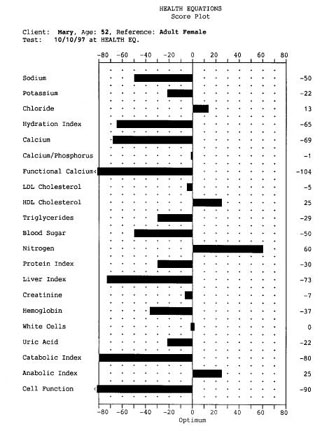
Mary had a Health Equations Blood Test Evaluation performed primarily because she was concerned about developing osteoporosis. At 50, Mary had no menopausal symptoms, but she was also anxious about maintaining a healthy menopause. Mary has always had an active lifestyle, running four miles 4 or 5 times per week, and hiking, biking, gardening, cross-country skiing and playing tennis seasonally. She had been taking calcium supplements for 22 years.Mary is the mother of four children, all teenagers and young adults. She is 5'10" and weighs 143 pounds. She had severe leg and feet cramps, sore and inflexible muscles, and "heart irregularities" at night whenever she stopped running.
Mary's first Score Plot shows a Calcium Score of minus 69, a Functional Calcium Score of minus 104, and a Catabolic Index of minus 80. What did these scores mean in Mary's case? A Calcium Score of minus 69 meant Mary did not get the calcium she needed in spite of her 22 years of supplementing. The Functional Calcium (FC) is the usable or available calcium. It is the free, unbound calcium that can be used by nerves, muscles, and hormone messengers right now.Mary's FC Score was so low, minus 104, because her Calcium Score and Catabolic Index (CI) were so low. A low Cl means minerals, including calcium, get bound up in the tissues and are therefore no longer available, including to her bones.
Mary's initial Score Plot also had a Sodium Score of minus 50. Upon inquiry Mary indicated she was cooking with one half the recommended salt and did not add salt at the table. Moreover "pretzels and canned soups are too salty" but she did eat "a small amount of salted chips a few times a week."
Salt is anabolic, the opposite of catabolic. Anabolism and Catabolism are two continuously interactive processes that create the body's metabolism. Health is a balance between the two. Anabolism is the process of building, Catabolim is the process of breaking down. (See Metabolism, and Understanding Your Metabolism.) Since salt is Anabolic, it can balance excess Catabolism. Therefore it can improve Mary's Catabolic Index (minus 80). Mary's leg cramps and heart irregularities both occurred at night. These are catabolic symptoms, and catabolic symptoms are often worse at night. It is probable that Mary's sodium deficiency has been significantly contributing to her leg cramps and heart irregularities.
|
Page
1
HEALTH EQUATIONS
Example Blood Test Evaluation: Mary INTERPRETATION Low Sodium:
Low Hydration Index:
Low Serum Calcium:
Low Functional Calcium:
Low Triglycerides:
Low Blood Sugar:
|
Page
2
Low Liver Index Score:
High Nitrogen:
Low Hemoglobin:
Low Catabolic Index:
Low Cell Function Score:
|
In compliance with her Recommendations, Mary took double strength Lyte Solution (with milk), increased her salt use, and took four each of the Health Equations Calcium and Health Equations Minerals capsules per day. She also increased her dietary protein and decreased her carbohydrate intake in accordance with her Individual Food Plan.Two months later Mary's overall energy was much better, "great!" She was "way more alert," even though she had stopped caffeine (3 cups black tea a day). She had no cramps and no heart irregularities. A repeat Score Plot shows improvements in Mary's Calcium, Functional Calcium, and Catabolic Index Scores. Mary's Calcium Score increased on the Healtb Equations Calcium because it is a readily absorbable source of calcium. (See Health Equations Calcium and Minerals.)
Mary's Catabolic Index will continue to improve with adequate dietary protein, the right kinds and proportion of dietary fat, salt to taste (See Water and Salt), and a decrease in activity (she also has four jobs). As her CI further improves, so will her Functional (available) Calcium.
Does Mary have osteoporosis? She must consult her physician for a bone density scan to answer this question. Meanwhile she is correcting her calcium and sodium metabolisms as well as eating adequate protein, all necessary for healthy bones. Mary's exercise should be in her favor toward preventing osteoporosis. However, several other factors need to be considered. Excess exercise increases cortisol, an adrenal stress hormone. Cortisol causes osteoporosis. Cortisol can also elevate the Nitrogen Score on the Blood Test Score Plot. Mary's Nitrogen Score is plus 60. Oops! But dehydration can also increase the Nitrogen Score. Mary drinks six cups of water daily (See Water and Salt). Is Mary dehydrated? Yes, her Hydration Index is minus 65. However, a functional liver and functional adrenals are essential for functional hormones at every age. Therefore we want to see improvements not only in the Catabolic Index and the Sodium, Calcium, Functional Calcium and Hydration Index scores, but in the Liver Index and Blood Sugar (one indicator of adrenal function) scores as well.
Another Blood Test Evaluation is recommended for Mary after she follows the Food Plan and lifestyle changes, and takes Health Equation Formulas for 3 months. Her Recommendations in each of these areas will be adjusted according to the comparison of her two Score Plots, as well as to her improvements or lack thereof. In particular, there will be recommendations for Standard Process Whole Food Supplements if adrenal and liver function do not improve during the first three months on Health Equations. Sometimes improving body chemistry is sufficient to correct gland and organ dysfunction, a result of poor body chemistry. Other times Whole Food Supplements are also necessary to restore gland and liver function.
Finally, Mary's low Catabolic Index does not portend well for menopause. Menopausal symptoms are catabolic symptoms. Does this mean she will need to take hormones? Hormones may not be needed either for menopausal symptoms or for bone health if she follows her Recommendations, Individual Food Plan, and lifestyle changes indicated above.
GO TO: HEq HOME about HEq RETURN TO TOP OF PAGE
© 2001 Health Equations all rights reserved