
Dr. Emanuel Revici
by Lynne August
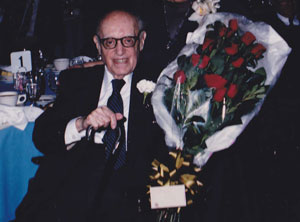 At a medical conference 30 years ago in San Diego, a fellow physician gave me a copy of Dr. Revici’s “book”, Research in Physiopathology as a Basis of Guided Chemotherapy, With a Special Application to Cancer. I was riveted, and although I had never heard of Dr. Revici, I boarded a red-eye to meet him the next morning at his clinic in Manhattan.
Seventeen years earlier, while living with my family on Staten Island, I witnessed the suffering that marked the last three years of my grandmother’s life. Her suffering wasn’t her cancer or even her dying or impending death; she suffered from the effects of merciless treatments she had endured throughout the 1950’s and again in the 1960’s, all the “compassionate” attempts to save her life.
My grandmother’s suffering lit a fire in me. There had to be another way. So I took a sharp turn on the road to becoming a physicist and became a doctor instead. I was determined to understand cancer from different angles and seemingly disparate disciplines.
The more I discovered about Dr. Revici and his work, the more captivated I became. Not only did he understand cancer and its treatment from an entirely new perspective, he did so by applying quantum physics to medical sciences, adding dimensions to medicine never before (or since as it turns out), realized. As a once-aspiring physicist, Dr. Revici’s work inspired me deeply. As a physician, I felt compelled, and in some palpable way responsible, to understand Dr. Revici’s ability to control pain and achieve remissions in terminal cancer patients with his non-toxic “guided chemotherapy”, even many cancers that conventional therapy failed to control.
To this day I remember Dr. Revici in his clinic graciously paying undivided attention to each patient, listening intently in one of the five-and-a-half languages he spoke (the half being English), examining them and reviewing their records in great detail and with utmost care. He would become silent, often closing his eyes, then emerge with a novel question about that patient, a problem only he could solve. Most of the time his questions and solutions were as unprecedented as they were effective.
I returned to my practice in Oregon, intermittently visiting with Dr. Revici at his clinic and home in NYC over the next five years. While in Oregon I consulted with him frequently, often several times a day regarding my patients. Embossed in my memory is a 32-year-old woman referred to me for extreme PMS. Her symptoms did not respond to supplements, hormones, acupuncture, homeopathy, prescription medications or psychotherapy, and her premenstrual violent behaviors led to legal charges and a court ordered probation. Dr. Revici recommended one of his “therapeutic agents” for her, which once administered took immediate effect. She was symptom free in less than 3 months and released by the court in less than a year.
Between 1936 and 1941, Dr. Revici pursued research opportunities in Paris unavailable to him in his native Romania. During this time the Pasteur Institute published five of Dr. Revici’s papers in the National Academy of Sciences. Unfortunately, even with such prestigious recognition, there would be sparse opportunity for Dr. Revici to publish his work for the rest of his life.
Being Jewish, Dr. Revici and his family were forced to flee Europe as WWII engulfed France. They were first granted asylum in Mexico, where he established his Institute of Applied Biology, which he re-founded seven years later in Brooklyn. Yet within a few years of crossing the Atlantic, the AMA would disparage Dr. Revici’s theories and treatments while the American Cancer Society sought to “black list” him and discredit his work. His license to practice medicine was challenged on numerous occasions over the ensuing decades, even until his death in 1997 at 101.
Despite persistent attempts by Dr. Revici and his colleagues to publish their work in peer-reviewed literature, all were consistently denied. Determined that his theories and discoveries be published in spite of peer rejection, Dr. Revici published his “book” (a 772 page treatise compiling his work - his direct perceptions, theories, laboratory research and clinical investigations through 1960).
A poignant irony for me is that the distance between Dr. Revici and my grandmother in the 1950’s was a Staten Island ferry ride to Brooklyn. Further, Dr. Revici had the understanding of, and treatment for, cancer that scientists and doctors were looking for all along and he was more than eager to work with them. As with many scientists whose advances were well ahead of their time, Dr. Revici was considered a heretic.
I often witnessed Dr. Revici and his work being challenged. Invariably he would turn towards me afterwards, saying “If I see it I cannot say it is not true. Someday they will understand.” He knew unequivocally that what he observed was irrefutable; like Galileo, he never doubted it would be recognized, even if well after his lifetime.
Many of Dr. Revici’s findings have gone on to become replicated or newly documented. Others have been incorporated into modern practice and research without knowledge or acknowledgement of their origins. Even a Nobel Prize was awarded in 1982 to a contemporary scientist for a discovery Dr. Revici made in Paris in the 1930’s. Fortunately, there is far more to come; Dr. Revici’s work is a diamond that can be appreciated now more that ever given the advances in scientific and medical technologies.
Dr. Revici regarded the treatise he published in 1961 as a beginning, the foundation for others to build upon, reaching even greater insight and understanding to relieve human suffering. His treatise - including extensive chapter notes and a twenty-page bibliography – lays the groundwork for enough research to keep hundreds of scientists across many disciplines engaged to advance Dr. Revici’s vision for 21st Century Medicine.
Please visit DrRevici.com for more information.